Beyond the Blueprint: How Our Application Engineers Solve the Unsolvable
Application Engineers at Tokai Carbon Graphite Solutions serve as the critical link between complex industrial challenges and advanced material science. They analyze thermal, chemical, and mechanical requirements to select the perfect carbon grade, ensuring optimal performance for high-stakes semiconductor and aerospace clients.
More Than Just Machining
Many manufacturing shops simply follow instructions. A client sends a drawing, and the shop cuts the part. However, at Tokai Carbon Graphite Solutions (TCGS), we operate differently. We believe that true value lies in the “why” and the “how,” not just the “what.”
Consequently, our Application Engineers are not just order-takers. Instead, they are consultants. They are detectives. Clients often arrive with a broken process or a failing part. Then, it is up to our team to find the fix.
This collaborative approach defines our culture. We don’t just want you to run a calculation. We want you to solve the puzzle.
Case Study 1: The Permeability Puzzle
Recently, a semiconductor client faced a critical failure. They were using a standard isostatic graphite crucible for a liquid phase epitaxy process. Unfortunately, the molten material was infiltrating the porous graphite walls. This caused contamination and rapid part failure.
The client assumed they needed a denser grade of standard graphite. However, our Application Engineers dug deeper. They realized that any standard graphite would eventually leak due to inherent porosity.
The Solution:
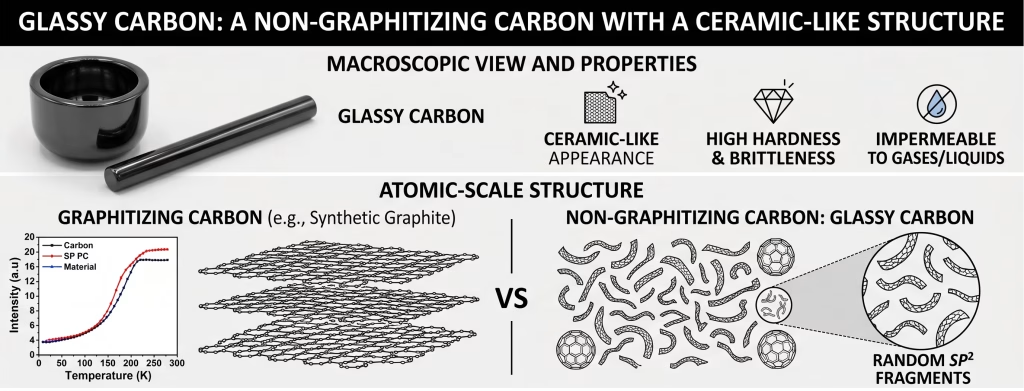
Our team recommended Glassy Carbon.
- The Material: Glassy Carbon is a non-graphitizing carbon with a ceramic-like structure.
- The Benefit: It is impermeable to gas and liquids.
- The Result: The infiltration stopped immediately.
By switching materials completely, we extended the component’s life by 300%. Thus, the client saved thousands in downtime costs.
Case Study 2: The Weight of Thermal Shock
In another instance, a heat-treat furnace operator came to us with cracked fixtures. They were using massive, heavy graphite blocks to hold steel parts during quenching.
The rapid cooling was causing thermal shock. Furthermore, the sheer weight of the fixtures was damaging the furnace hearth. They asked for a stronger block.
Once again, our Application Engineers challenged the premise. A bigger block would only absorb more heat and crack faster.
The Solution:
We redesigned the fixture using Carbon/Carbon (C/C) Composites.
- The Material: C/C composites are reinforced with carbon fiber.
- The Benefit: They boast incredibly high tensile strength and low thermal mass.
- The Result: We reduced the fixture weight by 50%. The cracking stopped because the thin composite walls shed heat instantly.
Case Study 3: The Dust Defense
A solar cell manufacturer was battling particle generation. Their graphite heaters were degrading, releasing dust that ruined their silicon wafers. They requested a harder graphite grade.
Our Application Engineers knew that hardness wasn’t the issue; chemical attack was. The process gases were etching the graphite binder.
The Solution:
We proposed a Chemical Vapor Deposition (CVD) Silicon Carbide coating.
- The Process: We applied a dense SiC layer to seal the surface.
- The Benefit: This created a chemical barrier against the etching gases.
- The Result: Particle counts dropped to near zero.
Join a Team of Solvers
This is the daily reality for Application Engineers at TCGS. You won’t spend your career staring at the same blueprint. Instead, you will face new challenges from the world’s most advanced industries.
We need minds that question the status quo. We need engineers who understand that the drawing is just the starting point.
Are you ready to be a consultant, a scientist, and a problem-solver?
Frequently Asked Questions (Q&A)
Q1: What is the primary role of Application Engineers at TCGS?
A1: They bridge the gap between a customer’s problem and our material capabilities. Application Engineers assess the operating environment to recommend the specific grade of graphite or coating that will survive.
Q2: How does Glassy Carbon differ from standard graphite?
A2: Glassy Carbon has a disordered, glass-like structure. Unlike standard graphite, it has zero open porosity, making it impermeable to gases and liquids without any coating.
Q3: When should I use C/C Composites instead of solid graphite?
A3: You should choose C/C composites when you need high strength-to-weight ratios or resistance to extreme thermal shock. Application Engineers often specify them for furnace baskets and structural fasteners.
Q4: Do Application Engineers work with R&D teams?
A4: Yes. They frequently collaborate with client R&D teams to develop custom solutions for experimental processes, often creating prototypes that have never existed before.